Showing posts with label Opensource. Show all posts

Monday, October 08, 2007

Reading Logfiles will never be the same again :)

Nice one .. check it out.

Would it be nice if we can read the logfiles in a graphical visualization and Realtime... err let me remind again REALTIME! :)


View real-time data and statistics from any logfile on any server you have SSH access to, in an intuitive and entertaining way.

http://www.fudgie.org/

FEATURES

  • Multiple logfiles on multiple servers
    (via SSH & tail)
  • Configurable layout
  • Multiple logfile parsers
    (Apache Combined, Rails, IIS & Postfix included)
  • Show only data you're interested in
  • Custom events
  • Show rate, total or average
  • If you can 'tail' it, you can visualize it
  • Written in Ruby using net-ssh & libopengl-ruby
  • Free! (GPLv2)


Sunday, September 16, 2007


TestDisk - CGSecurity

http://www.cgsecurity.org/wiki/TestDisk

is OpenSource software and is licensed under the GNU Public License (GPL).

TestDisk is a powerful free data recovery software! It was primarily designed to help recover lost partitions and/or make non-booting disks bootable again when these symptoms are caused by faulty software, certain types of viruses or human error (such as accidentally deleting your Partition Table). Partition table recovery using TestDisk is really easy.

TestDisk can

  • Fix partition table, recover deleted partition
  • Recover FAT32 boot sector from its backup
  • Rebuild FAT12/FAT16/FAT32 boot sector
  • Fix FAT tables
  • Rebuild NTFS boot sector
  • Recover NTFS boot sector from its backup
  • Fix MFT using MFT mirror
  • Locate ext2/ext3 Backup SuperBlock

Operating System

TestDisk has features for both novices and experts. For those who know little or nothing about data recovery techniques, TestDisk can be used to collect detailed information about a non-booting drive which can then be sent to a tech for further analysis. Those more familiar with such procedures should find TestDisk a handy tool in performing onsite recovery.

under
  • DOS (either real or in a Windows 9x DOS-box),
  • Windows (NT4, 2000, XP, 2003),
  • Linux,
  • FreeBSD, NetBSD, OpenBSD,
  • SunOS and
  • MacOS
Filesystems

TestDisk can find lost partitions for all of these file systems:

  • BeFS ( BeOS )
  • BSD disklabel ( FreeBSD/OpenBSD/NetBSD )
  • CramFS, Compressed File System
  • DOS/Windows FAT12, FAT16 and FAT32
  • HFS and HFS+, Hierarchical File System
  • JFS, IBM's Journaled File System
  • Linux Ext2 and Ext3
  • Linux Raid
    • RAID 1: mirroring
    • RAID 4: striped array with parity device
    • RAID 5: striped array with distributed parity information
    • RAID 6: striped array with distributed dual redundancy information
  • Linux Swap (versions 1 and 2)
  • LVM and LVM2, Linux Logical Volume Manager
  • Mac partition map
  • Novell Storage Services NSS
  • NTFS ( Windows NT/2K/XP/2003/Vista )
  • ReiserFS 3.5, 3.6 and 4
  • Sun Solaris i386 disklabel
  • Unix File System UFS and UFS2 (Sun/BSD/...)
  • XFS, SGI's Journaled File System


Wednesday, April 07, 2004

NAGIOS


What is Nagios


Nagios® is a host and service monitor designed to inform you of network problems before your clients, end-users or managers do. It has been designed to run under the Linux operating system, but works fine under most *NIX variants as well. The monitoring daemon runs intermittent checks on hosts and services you specify using external "plugins" which return status information to Nagios. When problems are encountered, the daemon can send notifications out to administrative contacts in a variety of different ways (email, instant message, SMS, etc.). Current status information, historical logs, and reports can all be accessed via a web browser.

Features

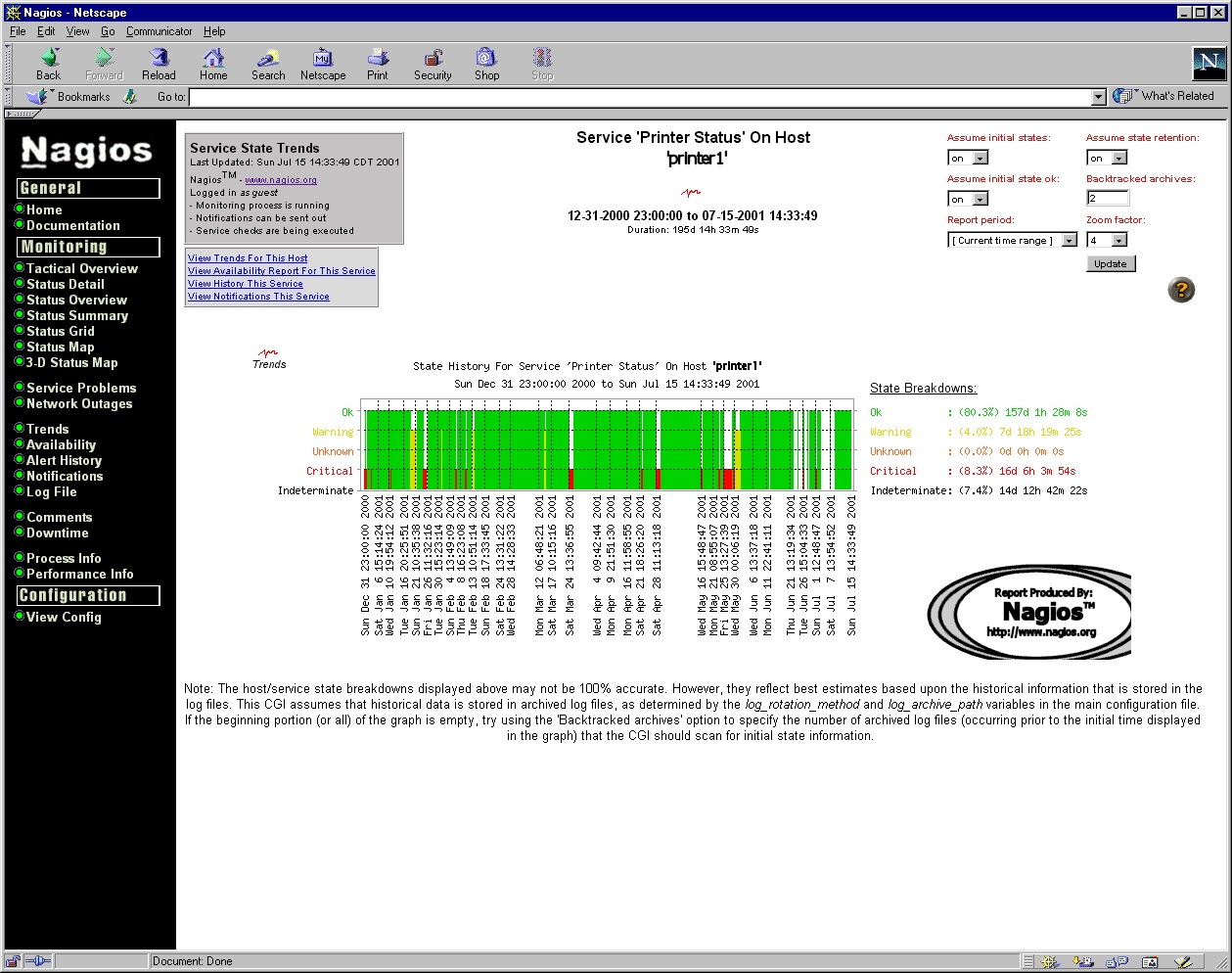
Trends screen 3-D status world screen Service problems screen


Nagios has a lot of features, making it a very powerful monitoring tool. Some of the major features are listed below:

  • Monitoring of network services (SMTP, POP3, HTTP, NNTP, PING, etc.)
  • Monitoring of host resources (processor load, disk and memory usage, running processes, log files, etc.)
  • Monitoring of environmental factors such as temperature
  • Simple plugin design that allows users to easily develop their own host and service checks
  • Ability to define network host hierarchy, allowing detection of and distinction between hosts that are down and those that are unreachable
  • Contact notifications when service or host problems occur and get resolved (via email, pager, or other user-defined method)
  • Optional escalation of host and service notifications to different contact groups
  • Ability to define event handlers to be run during service or host events for proactive problem resolution
    Support for implementing redundant and distributed monitoring servers
  • External command interface that allows on-the-fly modifications to be made to the monitoring and notification behavior through the use of event handlers, the web interface, and third-party applications
  • Retention of host and service status across program restarts
  • Scheduled downtime for supressing host and service notifications during periods of planned outages
  • Ability to acknowlege problems via the web interface
  • Web interface for viewing current network status, notification and problem history, log file, etc.
  • Simple authorization scheme that allows you restrict what users can see and do from the web interface


Mainpage
http://www.nagios.org

screenshots
http://www.nagios.org/screenshot.php

Tuesday, July 29, 2003

Window Manager - WindowMaker Stuff
Window Maker Page :http://windowmaker.org/
Window Maker Themes :http://themes.freshmeat.net/browse/918/?topic_id=918
Largo's Window Maker page :http://largo.windowmaker.org/
Window Maker DockApp Warehouse :http://www.bensinclair.com/dockapp/
Gürkan Sengün's Dockapp listing :http://www.linuks.mine.nu/cgi-bin/da.sh
Login app for WindowMaker :http://largo.windowmaker.org/Login.app/
Window Maker Projects :http://windowmaker.org/projects.html